Kimberly Rooney: Intersectional Pride
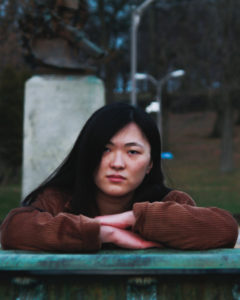
Kimberly Rooney 高小荣 (they/them) is a Chinese adoptee from Jiangsu Province. They work as a copy editor at Prism Reports, a nonprofit newsroom led by people of color that focuses on intersectional injustice and empowering the most affected communities to tell their own stories. Kimberly came to Pittsburgh in 2015 to attend the University of Pittsburgh, where they graduated in 2019 with a double major in English fiction writing and communication rhetoric with a minor in Chinese. For their communication degree they defended a thesis through the Honors College’s Bachelor of Philosophy program on racial identity formation in Chinese American adoptees. Their creative writing has appeared in The Offing, Chestnut Review, Longleaf Review, and Jellyfish Review, among others, and has been recognized as a 2022 Best of the Net finalist.
Would you tell me about your journey to find community when you don’t always see yourself represented?
I see my experiences, both personally and professionally, through the identity lenses of being both Queer and Asian in Pittsburgh, and the intersections between those identities. While there have been more groups in recent years that have focused on this particular intersection, including AQUARIUS at Pitt and Rangoli Pittsburgh, in general when I moved to Pittsburgh it was difficult to find community among Queer Asian people. When I made attempts to be in Queer spaces in Pittsburgh, I felt really alienated for being Asian. Those spaces were just overwhelmingly white, and I felt like there was a sense that I wasn’t Queer enough, because I didn’t fit into certain white Queer aesthetics. For example, I talked to so many white Queer people throughout undergrad and there was always at least one mention or suggestion for me to shave or dye my hair. I’m not going to do that to my hair!
I struggled with realizing that I was nonbinary for a really long time, because so many people just looked at my hair and perceived me as a woman. Being nonbinary was something that I didn’t even realize that I could have for myself until I was out of college and started finding other Asian Queer people and realizing that this is something that I can be, and I don’t have to prove myself through these aesthetics. That was a sentiment that came up over and over again among the Queer Asian people I met. While I’m so glad I found those people, it didn’t feel like there was a central space for us to inhabit or connect through.
It’s also challenging because while there’s that frustration with white Queer spaces, there’s also homophobia and transphobia within Asian spaces. That becomes very difficult to talk about, especially now when there are so many anti-Asian hate crimes and rising anti-Asian sentiment. It feels like the burden is on Queer Asians to not talk about these issues within our own communities. It feels like we’re being told, “Why would you paint a target on the Asian community and invite this external criticism on us when we’re already dealing with so much?”
That feels so unfair, because these are issues that we face within this community, and Queer Asians are still Asian, just as much as any cisgender heterosexual Asian is! I imagine pretty much any marginalized person experiences not wanting to invite the wrath of the dominant culture onto themselves and their community. I feel because in these spaces there is so much lack of acceptance, we ended up getting really splintered.
I have over time been able to spend time in groups where it’s only or mostly Queer Asian people, and that’s been awesome. It feels like a sigh of relief in finding each other. I wish that I had spent more time trying to find other Queer Asian people because for a long time a lot of us individually felt really isolated and then accepted that. I almost just gave up on looking, and it wasn’t until more recently that I intentionally sought it out again. I am optimistic that the existing Queer Asian communities will grow and that there will be more organizations and community groups in the future.
Can you talk to me more about the solidarity and community you find within these groups that center specific intersectionalities?
I’ve been able to find a lot of joy and community within these smaller groups. We can often connect over political understanding and agreements that allow for fewer points of tension. But even within these specific groups, the labeling of the “Asian community” is so broad. It encompasses so many different people in so many different socio-economic backgrounds and different immigration histories and understandings of the world.
I do feel complicated as well about continuously compartmentalizing into more and more specific intersectionalities in order to create the space that meets your specific set of intersections. There has been more critique and analysis that I’ve been appreciative of lately about pushing back against this tactic. We historically have achieved material and political gains by working together by having solidarity and coalition building, by realizing that we have these different intersections and still fighting together for these common goals towards liberation.
But it hurts a lot both emotionally and materially to be told by the “umbrella” group that your specific identities don’t matter as much as the shared identity that is in that group. There’s a long history of “wait your turn” politics, and it’s not actually radical or liberatory for larger groups to ask for solidarity, if those parts of yourself are still not fought for.
I don’t begrudge anyone for living within their more specific communities that they can connect the most with. Joy is so important, within revolutionary work. And if you don’t feel joy in the groups that you’re in and the people that you’re fighting with it’s so much harder to sustain any kind of movement.
How do you connect with the concepts of healing and resiliency?
There’s so much pressure for us to just deal with whatever white supremacy throws at us. I think we should fully acknowledge how painful and traumatizing it is. I don’t think a focus on resiliency and strength alone are the way forward. At least in my experience, that has not been conducive to healing.
When the Atlanta shooting happened I covered two of the protests that happened in response. I was encouraged and pressured to work through it, and I did, to my own emotional detriment. During the second protest that I covered there they held eight minutes of silence. During that pause, I started crying uncontrollably. I didn’t know what to do, because I was covering it live, I had a story to write up afterwards, and I was on a deadline. So I just tamped down on it and kept working.
It was hard afterwards when people complimented my coverage of it. They would comment on my strength and resiliency for covering a situation when it was my own community that got massacred. At the time I gave general responses about how it was difficult but I was glad to do the work. That is still true. But as time passes, and especially now that I’ve left that workplace and I’ve had more time to reflect on it, the more I realize that that was incredibly harmful to me, and it was harmful to be asked and pressured to do it. It wasn’t until this year when there was a one-year anniversary rally for Atlanta when I was able to attend, not as a journalist, but just as myself, that I felt like I was able to process it fully for the first time. Just be able to cry and not feel pressured to tamp it down and keep going.
I’ve been thinking a lot about how there has been so much solidarity that I have seen in response to these shootings because, unfortunately, so many different marginalized groups are targeted. It’s a shared understanding that we have now, which is horrible. I wish that the connections and solidarity could solely come from joy and sharing our cultures with one another. It’s so exhausting to just constantly have to live with this. But I do hope that if there is empathy to be extended during these times that it can be foundational for further coalition building. I really, really hope that because white supremacists are already organized. And we gain nothing by fighting separately.